
Observe corporate boardrooms across any major enterprise this year, and you will witness an eerily familiar scene playing out:
Every operational department is racing to deploy artificial intelligence (AI). Marketing rolls out automated campaign generators; customer support integrates conversational assistants powered by Large Language Models (LLMs); finance experiments with automated cash flow summary bots; and IT operations pilots autonomous agents to resolve service desk tickets.
On paper, innovation metrics appear to be soaring. Yet, when annual financial audits roll around and the board asks the inevitable question—“What is the net return on investment (ROI) that has actually hit the bottom line across all these initiatives?”—the room falls dead silent.
In their opening keynote at the prestigious Gartner IT Symposium/Xpo™ 2026, titled “Balance Compounding AI Value and Risk”, Gartner analysts unveiled a sobering set of statistical realities behind this hype cycle:
The average enterprise increased its number of AI use cases by more than 400% in a single year. Yet, amidst this flurry of activity, only one in five AI use cases (20%) delivers a positive return. Worse still, 86% of CIOs report that AI risk is compounding faster than AI value—four times faster, on average.
We are witnessing what can aptly be termed the AI Compounding Paradox: activity increases exponentially, value creation crawls incrementally, while systemic risks compound at an alarming pace without structural guardrails.
How should Chief Information Officers (CIOs), enterprise architects, and software engineering leaders respond to this dangerous imbalance?
1. The Anatomy of Disconnect: Incremental Value vs. Compounding Risk
Why does AI behave fundamentally differently from traditional software modernization projects, such as cloud migrations or core ERP overhauls?
In traditional, deterministic software engineering, risk and value are largely linear and bounded. When you release a new payments API, once integration, unit, load, and penetration tests pass, operational risk decays predictably over time as stability increases.
By contrast, AI operates as a non-linear compounding system:
        Systemic Impact
                 ▲
                 │                                   / Compounding AI Risk
                 │                                  /  (Grows 4x Faster on Average)
                 │                                 /   - Legal, Regulatory & Compliance
                 │                                /    - Transactional Hallucinations
                 │                               /     - Uncontrolled Token Cost (FinOps)
                 │                              /      - Human Skill Erosion
                 │                             /
                 │   ─────────────────────────/───────
                 │                           /         Realized Business Value
                 │                          /          (Incremental: Only 20% ROI)
                 │                         /
                 └────────────────────────────────────► Time / Number of Use Cases
- Value Accumulates Incrementally: Most AI initiatives in production today provide microscopic efficiency gains—saving 10 minutes on email drafting or summarizing slide decks. These micro-efficiencies rarely consolidate into top-line revenue growth or defensible market advantages.
- Risk Compounds Exponentially: When dozens of models, autonomous agents, and third-party APIs are wired directly into enterprise production workflows, they forge invisible chains of accountability. A single stochastic error in a billing agent can trigger incorrect ledger debits, legal liability, regulatory inquiries, and unmonitored compute token spikes.
Left unchecked without intentional architectural governance, compounding risks will inevitably outpace value and erode enterprise stability.
2. The Gartner Value-Risk Flywheel: Momentum vs. Drag
To counterbalance this systemic divergence, Gartner introduced the Value-Risk Flywheel framework. It conceptualizes enterprise AI not as a static catalog of tools, but as two interlocking feedback loops: the Value Loop and the Risk Loop.
For systems architects and technology leaders, the primary objective is steering two fundamental organizational forces: Momentum (propulsion) and Drag (friction).
A. Good Momentum vs. Bad Momentum
- Bad Momentum: Occurs when an organization launches dozens of isolated AI initiatives simply for the sake of activity. Every business unit builds isolated tech silos, procures disjointed vendor licenses, and duplicates data pipelines. The net result is sprawling technical debt, inflated subscription costs, and acute proof-of-concept fatigue.
- Good Momentum: Built not by multiplying random experiments, but through component reuse, deep organizational trust, fundamental work redesign, and scaling verified successes.
B. Good Drag vs. Bad Drag
Product managers and developers frequently view all governance and regulation as enemies of innovation. Gartner argues that this dichotomy is flawed. Friction must be consciously categorized into two distinct types:
- Bad Drag (Destructive Friction): Bureaucratic roadblocks that slow teams down without meaningfully mitigating systemic risk. Examples include waiting three weeks for a manual review committee to approve an internal prompt template, or navigating archaic vendor procurement checklists. Bad drag paralyzes engineering teams and actively incentivizes dangerous Shadow AI.
- Good Drag (Value-Protecting Friction): Programmatic guardrails designed to shield the organization from catastrophic failure without dampening velocity:
- Automated Evidence Trails: Cryptographically verifiable, immutable logging of prompts, model versions, context windows, and operational temperatures.
- Policy-as-Code Guardrails: Automated security middleware that intercepts and masks Personally Identifiable Information (PII) before requests hit external inference providers.
- FinOps Spending Discipline: Hard programmatic token quotas and budget alarms per department to eliminate run-away cloud bills.

3. Architectural Blueprint: The AI Central Bank as a Unified Control Plane
How can an enterprise govern Good Drag while accelerating Good Momentum at scale? The answer is not creating an ad-hoc steering committee, but establishing an AI Central Bank.
The banking metaphor is deliberate: just as a national central bank does not manage daily retail cash transactions, but instead sets monetary reserve ratios, regulates liquidity, and oversees financial stability, the AI Central Bank serves as the common control plane uniting the entire enterprise AI estate.
The AI Central Bank rests on four foundational pillars:
┌─────────────────────────────────────────────────────────────────────────┐
│                     AI CENTRAL BANK (CONTROL PLANE)                     │
├──────────────────┬──────────────────┬──────────────────┬────────────────┤
│  ACCOUNTABILITY  │    TECHNOLOGY    │    ECONOMICS     │  INTELLIGENCE  │
│   & GOVERNANCE   │                  │     (FINOPS)     │                │
├──────────────────┼──────────────────┼──────────────────┼────────────────┤
│ • Model Registry │ • Enterprise API │ • Token Quota &  │ • Drift & Bias │
│ • Access Policy  │   Gateway        │   Budgeting      │   Monitoring   │
│ • Legal & Ethics │ • Multi-Agent    │ • Unit Cost per  │ • Observability│
│   Compliance     │   Orchestrator   │   Transaction    │   & OpenTelemetry│
│ • Data Lineage   │ • Security       │ • Dynamic Model  │ • Automated    │
│   & Privacy      │   Guardrails     │   Routing (Cost) │   Audit Logs   │
└──────────────────┴──────────────────┴──────────────────┴────────────────┘
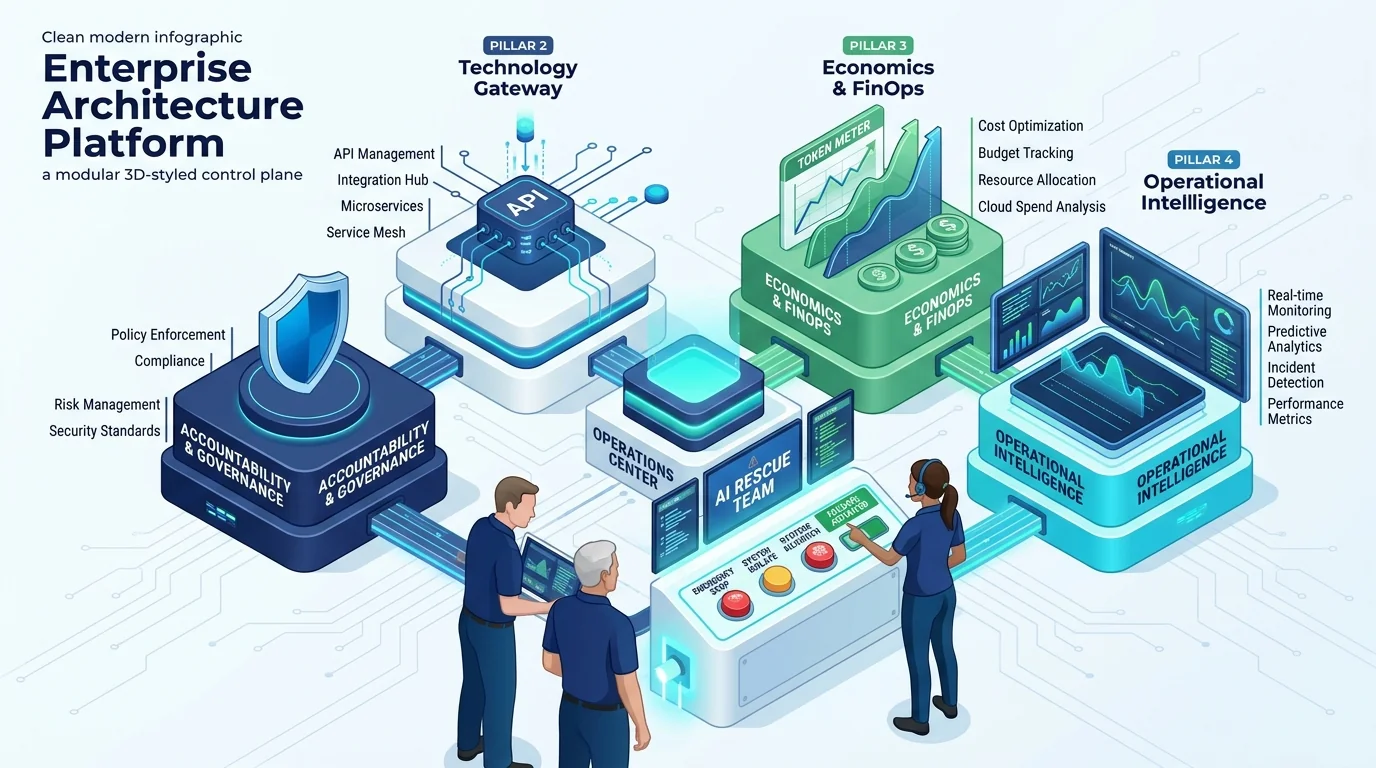
- Accountability and Governance: Defines explicit ownership for data lineage, copyright boundaries, and risk tiering across every use case. If an autonomous agent makes a flawed transactional decision, this pillar ensures deterministic audit trails and identified human stewards.
- Technology (Platform Engineering): Delivers a self-service internal developer platform (IDP). This includes a centralized Enterprise Model Gateway, a curated Model Registry, and reusable security guardrail libraries that developers can invoke via standard APIs without re-inventing basic safety scaffolding.
- Economics (FinOps for AI): Tracks and optimizes the unit economics of every inference call. The system dynamically routes basic summarization requests to cost-effective, open-weight models (e.g., local Llama or Mistral deployments), reserving expensive frontier reasoning models exclusively for mission-critical calculations. Budgets are enforced programmatically.
- Intelligence & Observability: Provides real-time operational telemetry. Tracks model accuracy drift, inference latency spikes, context window degradations, and prompt injection attempts across the entire application ecosystem.
4. The Last Line of Defense: AI Rescue Teams and Human Fallbacks
As AI systems evolve from passive chatbots to autonomous multi-agent networks, tracing non-deterministic decision trees becomes exponentially more difficult. No automated filter is completely infallible. Gartner’s sixth takeaway emphasizes that humans must remain the first responders and ultimate line of defense.
Mature enterprises are establishing specialized AI Rescue Teams:
A. Programmatic Kill Switches
When an autonomous agent enters a toxic hallucination loop, misinterprets state data, or suffers from adversarial prompt injections (dark AI), the rescue team must possess the tooling and authority to act instantaneously:
- Isolate compromised agent nodes from production networks.
- Revoke API authentication tokens and OAuth scopes globally in real time.
- Failover execution to deterministic, rule-based fallback systems without disrupting upstream availability.
B. Halting Skill Erosion
An insidious risk of unchecked automation is the degradation of institutional knowledge and critical reasoning skills. If junior analysts rely entirely on generative models to draft credit assessments, the organization will lose senior domain experts who possess the intuition required to spot model anomalies in high-stress scenarios.
AI Rescue Teams actively design workflows that retain human accountability on high-stakes decisions, ensuring institutional mastery is preserved rather than outsourced blindly.
5. Critical Reflection: Implementation Traps to Avoid
While Gartner’s conceptual framework provides exceptional strategic clarity, practical engineering requires confronting significant operational trade-offs:
1. The Risk of Centralized Bureaucracy
The title “AI Central Bank” can easily be hijacked by traditional corporate cultures as an excuse to establish bureaucratic “AI Approval Committees.” If developers must wait weeks for manual approvals to test a prompt, the organization inadvertently introduces the most toxic form of Bad Drag, driving engineering talent straight toward unsanctioned Shadow AI.
The AI Central Bank must be engineered as an Automated Self-Service Software Platform, not an analog rubber-stamping committee.
2. The Fallacy of the Simple “Kill Switch” in Distributed Systems
Triggering a kill switch in a distributed multi-agent system is fraught with edge cases. If an agent is abruptly terminated while mid-way through a distributed workflow (e.g., an inventory allocation was committed, but the corresponding payment capture has not completed), a naive kill switch will cause severe data inconsistency (split-brain). Systems architects must implement robust Saga transaction patterns and compensating actions before handing autonomous execution rights to agentic systems.
6. Actionable Roadmap: Four Steps for Enterprise Architects
For CIOs, Enterprise Architects, and Engineering Directors, here is a concrete four-phase roadmap:
flowchart TD
    A["Step 1: Portfolio Rationalization<br/>(Prune 80% toy experiments, double down on 20% ROI drivers)"] --> B["Step 2: Deploy Enterprise AI Gateway<br/>(Centralize token logging, PII masking, and rate limits)"]
    B --> C["Step 3: Architect the AI Central Bank Control Plane<br/>(Harmonize Governance, FinOps, Registry, and Telemetry)"]
    C --> D["Step 4: Institutionalize AI Rescue Teams & Kill Switches<br/>(Automated circuit breakers, dark AI defenses, disaster drills)"]
- Audit and Rationalize Your Use Case Portfolio: Stop treating AI activity as a proxy for progress. Conduct a ruthless portfolio audit. Kill the 80% of experimental pet projects that have no tangible path to EBITDA impact, and concentrate engineering talent on the 20% of use cases with validated ROI.
- Deploy a Centralized Enterprise AI Gateway: Enforce that all outbound LLM traffic passes through a unified API proxy. This immediately unlocks comprehensive spending visibility, token quotas, automated PII scrubbing, and regulatory auditability.
- Turn Governance into Policy-as-Code (Good Drag): Replace manual governance checklists with automated, code-based guardrails. Leverage open-source safety frameworks to enforce input/output validation without adding human latency to developer deployment pipelines.
- Form an AI Rescue Team and Test Circuit Breakers: Establish clear incident response playbooks for AI failures. Run periodic chaos experiments: What happens if an inference model hallucinates negative transaction prices? Can your systems isolate the offending agent and roll back state safely without manual panic?
Summary: Shifting from Hype to Engineering Rigor
The era of unconstrained AI experimentation and vanity proof-of-concepts has come to a definitive close. Long-term enterprise success in the autonomous era will not be measured by the sheer volume of models demonstrated in executive boardrooms, but by how rigorously you balance compounding value (Good Momentum) with programmatic guardrails (Good Drag).
By adopting the Value-Risk Flywheel and building an AI Central Bank anchored in sound platform engineering, your enterprise can bypass the 80% failure trap and build a resilient foundation for the autonomous future.
Comments