
For many system analysts and software engineers, the perceived ceiling of their career often plateaus around technical deliverables: designing Entity-Relationship Diagrams (ERDs), crafting normalized database schemas, drafting OpenAPI/Swagger specifications, and ensuring Jira sprint tickets close on schedule.
Yet, the moment you are invited into the executive boardroom (C-suite), the conversational terrain shifts dramatically.
Directors and executives do not debate whether PostgreSQL uses memory more efficiently than MySQL, or whether an event-driven architecture is aesthetically cleaner than REST APIs. They debate why operating margins are collapsing despite daily active users surging by 40%, how to allocate scarce working capital across three competing product lines, and how to defend against an aggressive price war launched by an agile competitor.
In that room, most technical professionals fall silent. Not from a lack of intelligence, but because they have been trained to view organizations as static entities (tables, rows, and rigid schema contracts), while enterprise businesses operate as dynamic systems governed by time delays and feedback loops.
In his recent book, Strategic Analytics: Towards AI-based Strategy Planning (Wiley, 2nd Edition, 2026), Prof. Martin Kunc unpacks the 30-year disconnect between quantitative modeling (Management Science / Operations Research) and the nuanced intuition of strategic management.
The convergence of Generative AI (GenAI) and system simulation presents an unprecedented opportunity for system analysts to evolve: transitioning from software scribes into strategic partners who model and stress-test executive decisions.
1. Rejecting the “Ticket Taker” Mindset: Becoming a Manager as Modeler
Michael Pidd (2009) and Martin Kunc (2026) emphasize a foundational principle of Management Science: models are not built to replace human thinking; they are tools for thinking (procedural rationality).
When an analyst acts merely as an order taker, their role is purely mechanical: product management requests a checkout cart feature, and the analyst creates the cart_items table. The analyst never stops to question whether an aggressive flash discount feature might cannibalize the gross margin of premium tiers in the subsequent fiscal quarter.
Simple Analogy: Pit Crew Mechanic vs. F1 Race Strategist
A mechanic checks whether spark plugs fire cleanly and tire pressures match standard specs while the car sits idle in the pit lane.
In contrast, the race strategist models tire compound degradation against the remaining laps, calculates the optimal pit window under fluctuating weather, and anticipates the competitor’s DRS response into turn three. Both understand the race car, but the strategist models the dynamics of time, feedback, and competitive interaction.
As a system analyst, you already possess an analytical foundation that many pure business graduates lack: you are intimately familiar with dependency graphs, race conditions, bottlenecks, and deadlocks.
These instincts are the exact ingredients required to model business strategy. The pivotal shift is moving your cognitive lens from Class Diagrams to Causal Loop Diagrams.
2. Transforming Database Rows into Stock and Flow
The fatal limitation of conventional SQL databases in strategic decision-making is their static snapshot nature. An orders table records transactions captured at this exact second, but it cannot illustrate how cash reserves and fulfillment staff fatigue will interact over the next six months.
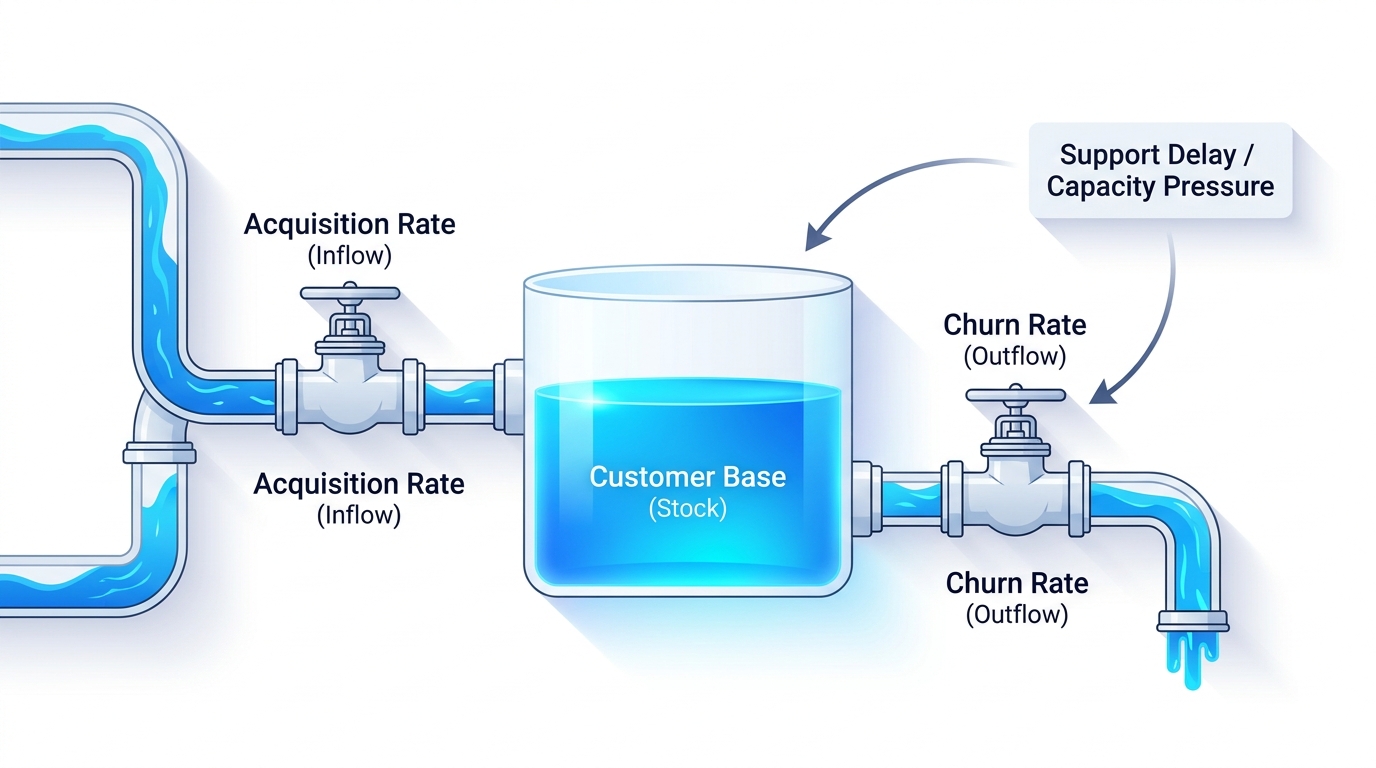
Under System Dynamics—a branch of operations research pioneered at MIT by Jay Forrester—any enterprise system can be deconstructed into two fundamental primitives:
- Stock (Accumulation/Reservoir): The state of a system that accumulates over time (e.g., liquid cash reserves, active subscriber base, institutional reputation, or accumulated technical debt).
- Flow (Rate of Change): The velocity of inflows or outflows that alter the stock level per unit of time (e.g., customer acquisition rate, churn rate, daily cash burn).
Simple Analogy: The Leaking Bathtub
Imagine a bathtub. The faucet pouring water is your marketing acquisition rate (inflow), the standing water in the tub is your active customer base (stock), and the drain at the bottom is your customer defection rate (outflow).
Amateur management, panicking over dropping water levels, often commands an immediate reaction: crank open the faucet (burn venture capital on digital ads).
A systems analyst trained in System Dynamics checks the drain first. If the drain is expanding due to severe customer support latency, pumping more water into the tub merely wastes capital and floods the bathroom floor without ever raising the water level.
When you walk into a product roadmap meeting and sketch this Stock-and-Flow relationship on the whiteboard, the discussion shifts from subjective opinion-mongering to objective, structural inquiry.
3. The Big Data Mirage: Why Historical Metrics Drive by the Rearview Mirror
Enterprise leaders frequently boast about petabyte-scale data warehouses and real-time operational telemetry. However, Kunc (2026) highlights a dangerous cognitive trap: Big Data is inherently backward-looking sensemaking.
Telemetry dashboards merely inform you of what has already transpired:
- “Sales dropped by 12% last month.”
- “Median API latency spiked to 450ms over the weekend.”
Conventional machine learning models (discriminative regression and classification) train their statistical parameters strictly on historical distributions. When the macroeconomic environment suffers structural disruption—such as new antitrust regulations, sudden currency devaluation, or an unexpected technological shift—historical patterns lose their predictive validity.
Steering enterprise strategy purely by historical dashboards is identical to driving a sports car at full throttle down a twisting mountain road while keeping your eyes glued to the rearview mirror.
To cultivate forward-looking foresight, organizations require causal simulation models. This is where System Dynamics and stochastic Monte Carlo simulations excel: they do not assume the future will mirror the past. Instead, they stress-test how organizational structural relationships react under unprecedented shock scenarios.
4. Orchestrating the “Human-AI Ensemble”: Putting Computers in the Group
One of the most consequential arguments in Martin Kunc’s second edition is redefining how artificial intelligence participates in strategy formulation.
Drawing on Thomas Malone’s work at the MIT Center for Collective Intelligence (2020), Kunc argues: we must stop thinking merely about “human in the loop”, and instead embrace “computers in the group” (Superminds).
In modern strategic planning teams, AI is not simply a query engine or glorified document search; it is an analytical peer with specialized responsibilities:
| Team Role | Entity | Core Function | Operational Nature |
|---|---|---|---|
| Synthesis & Divergence Partner | Generative AI (LLM) | Generating alternative scenarios, parsing unstructured market signals (text mining competitor reviews), and drafting initial mathematical formulations. | Divergent thinking, creative, probabilistic. |
| Constraint & Validation Engine | Management Science Solver (System Dynamics, Monte Carlo, LP Solvers) | Calculating deterministic boundaries, testing loop stability, and enforcing strict capital and infrastructure limits. | Mathematical, rigid, strictly grounded. |
| Architect & Strategic Facilitator | System Analyst (Human) | Evaluating organizational politics, ethical boundaries, validating model assumptions, and translating simulation findings into strategic execution. | Context-aware, ethical, final decision authority. |

Rather than writing differential equations by hand, a systems analyst can prompt an LLM to translate a narrative business problem into Python simulation code (e.g., using PySD for System Dynamics or SciPy/PuLP for linear programming), and then rigorously test its behavior against enterprise realities.
5. Production Realities: Critical Traps and Limitations
While Strategic Analytics offers an elegant paradigm, deploying it within real-world organizations involves hazardous friction points that every practitioner must navigate:
A. The Plausibility Trap (LLM Confabulation)
Large Language Models are optimized to generate statistically fluent, authoritative prose. When prompted for market expansion strategies, an LLM will deliver a crisp, five-point recommendation that reads like high-tier management consulting—even if its financial assumptions and underlying causal relationships are mathematically fictitious.
Mitigation: Never adopt raw generative text recommendations without binding their core parameters to deterministic solvers and verified operational telemetry.
B. Political and Organizational Friction
Strategic decisions inside enterprises are rarely made purely through rational calculus; they are heavily influenced by divisional budgets, executive egos, and stakeholder incentives.
If your causal simulation proves that a senior vice president’s pet project will exhaust the company’s operating runway within 18 months, your data will likely encounter aggressive emotional resistance.
Mitigation: Embrace Soft Operations Research facilitation. Conduct group model-building sessions. Invite stakeholders to define the variables and delay parameters themselves, transforming the simulation into a shared discovery rather than an adversarial confrontation.
C. The Over-Engineering Trap (“Mega-Models”)
A common pitfall for technical analysts exploring simulation is constructing colossal models containing 80 interconnected variables and dozens of feedback loops. Such architectures become impossible to calibrate and impossible for leadership to trust.
Mitigation: Abide by Michael Pidd’s rule: Start small, be parsimonious. A high-impact strategic model requires only 3 to 5 dominant variables with 1 or 2 critical feedback loops.
6. Actionable Steps: What You Can Start Tomorrow Morning
To initiate your transition from a specification writer to an enterprise strategist:
- Reframe Database Schemas into Stock-and-Flow Logic:
Inspect your primary production database. Select a core entity (e.g., active subscriptions, inventory items, or customer disputes). Sketch it on paper: What is the primary Stock? What Inflows replenish it? What Outflows deplete it? Where do the physical and operational Delays reside? - Shift Your Inquiry from “How” to “Systemic Consequence”:
When product managers demand a new high-throughput feature, stop asking only “What is the delivery timeline?”. Inquire: “If this feature succeeds and transactions surge 5x, what secondary operational bottleneck breaks? Is customer fulfillment prepared? Are downstream accounting reconciliation pipelines capable of absorbing this flow?” - Deploy AI as a Devil’s Advocate:
During system design reviews, prompt LLMs not just to write boilerplate code, but to roleplay as an aggressive competitor or a hostile auditor. Command the model to identify catastrophic failure modes in your assumptions under extreme macroeconomic volatility. - Master the Language of Enterprise Capital:
Familiarize yourself with Free Cash Flow, unit economics, Customer Acquisition Cost (CAC), and payback periods. When you can mathematically tie database query latencies to millions in prevented revenue leakage, the executive boardroom will listen with newfound respect.
Senior engineering leadership is not measured by the volume of code you commit, but by the clarity with which you model complex realities to steer the enterprise toward long-term resilience.
Comments